NASA announced a detailed plan Tuesday, May 26 to build a sprawling Moon Base in the coming years where American and international astronauts will not only return to the lunar surface but stay there this time to create the first sustained human presence on another world.
The goal is to construct a base over time stretching for hundreds of square miles near the Moon’s southern pole as an off-world foothold to test new technologies, expand a robotic presence, practice deep space habitation, and develop new science and survival skills needed for an eventual crewed mission to Mars, according to NASA officials.
The details of NASA’s three-phase plan included announcement of hundreds of million dollars in contracts for companies—including Blue Origin Enterprises, L.P., founded by Jeff Bezos—that will help NASA with commercial power and technology that can assist in lifting the cargo, new rovers, supplies and gear needed to start the work on a Moon Base and create the beginnings of a lunar economy.
The spectacular mission of NASA's Artemis II spacecraft that flew around the Moon last month laid the groundwork with a return of astronauts to deep space flight for the first time in more than fifty years as the crew of four flew farther out into space than any humans and used the moon’s gravity to slingshot around the Moon and return safely to Earth.
As I wrote then in the Chicago Tribune, it’s way past time America got serious again about space travel and human missions that go beyond low-Earth orbit and return us to deep space missions once again—and beyond.
This article by Storer Rowley was published April 12, 2026, Chicago Tribune.
It’s past time to get back to the task of human space exploration.
The astronauts aboard NASA’s Artemis II mission flew farther from Earth than anyone in history and laid the first human eyes on much of the moon’s far side. Their Orion spacecraft made its flyby this past week with the most diverse crew to get an unprecedented look at the lunar side that always faces away from Earth.
Those were among many breathtaking firsts in a mission that went, in NASA parlance, higher, faster and farther than any before it.
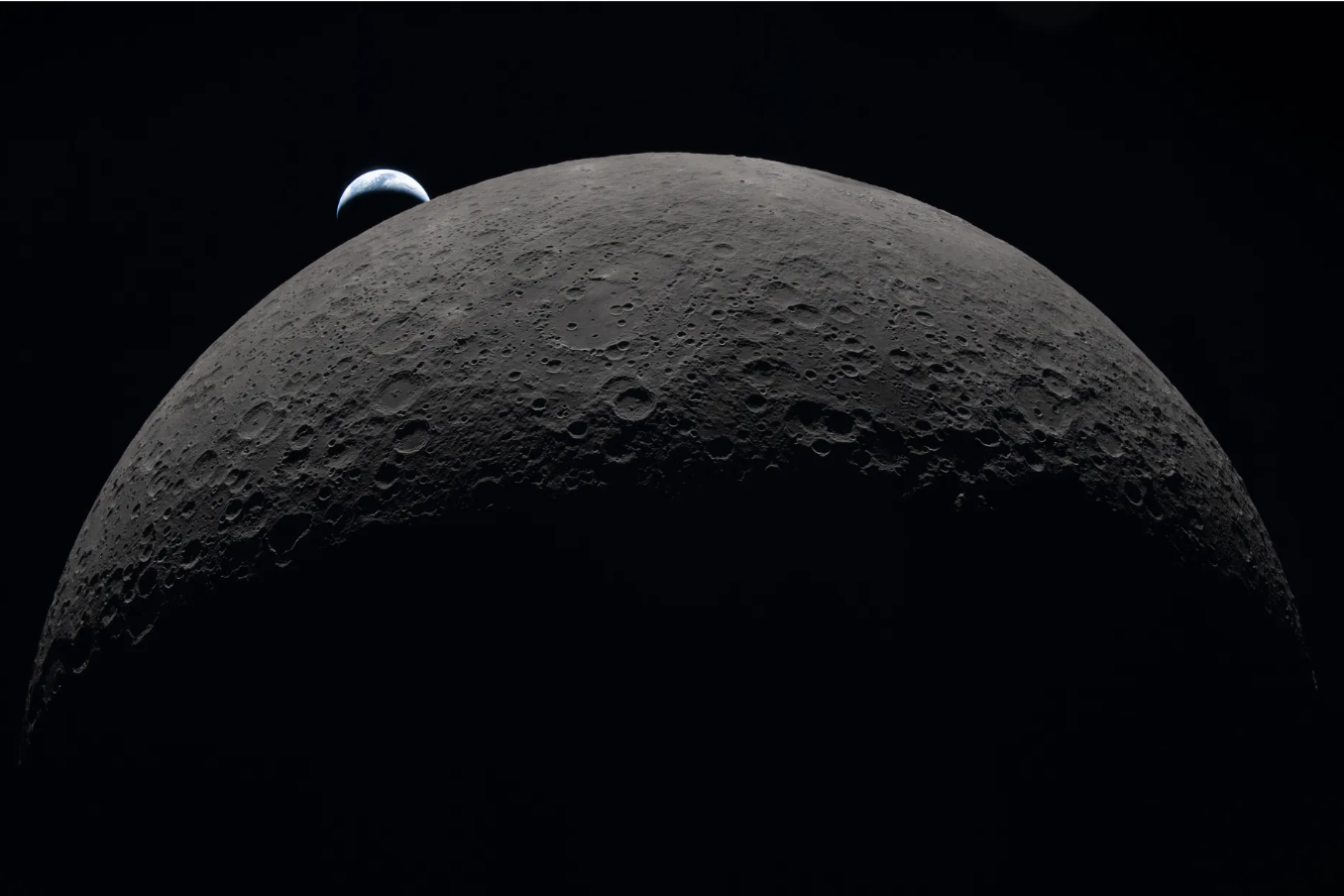
Earth sets over the moon’s curved limb in this photo captured by the Artemis II crew during their journey around the far side of the moon on April 6, 2026. (NASA)
As planned, this four-person crew didn’t orbit or land on the moon, but their 10-day mission is NASA’s first to send humans back there since 1972, when Apollo 17 astronaut and Chicago native Gene Cernan was the last of 12 men to leave footprints on the dusty lunar surface. The Artemis II crew photographed bright impact craters and ancient lava flows on the far side. They saw an “Earthset” and an “Earthrise,” along with a solar eclipse, and rediscovered the wonder of deep space travel.
So why did it take NASA 54 years to return? America won the space race to the moon with the Soviets but backed off because of high costs and risks — doing more with robotic missions to search for Earth-like planets and look toward Mars and outer planets in the solar system. The public saw the astronomical costs of these expeditions and questioned spending billions on space treks when so many problems still needed to be addressed here on Earth, from poverty and hunger to disease and climate change.
However, it should not be one or the other. We need to do both; multitasking is in our nature. The moon has always been the first steppingstone to the outer limits. We spent more than half a century in low-Earth orbit missions and learned a lot, but it’s way past time to get back to the task of human space exploration.
This time around, it also felt to some like we had done this before, so why bother? This mission is historic, and the media covered it, but it has garnered surprisingly less excitement and interest than before, when long ago, many people gathered outside appliance store windows in the 1960s to watch the moon landing broadcast on store TVs.
America still can and should do great things that inspire awe and pioneer final frontiers.
The last time people went to the moon, it was to visit. This time, America’s space program intends to stay and, in future Artemis program missions, set up a moon base where astronauts can explore the lunar South Pole, do planetary science, look for water, and see if discovery on the moon and deep space can build a foundation for crewed missions to Mars.
Most people alive when Apollo 11 astronauts Neil Armstrong and Buzz Aldrin landed and walked on the moon on July 20, 1969, remember where they were. I was 15 and listened to it on a transistor radio in the back of a pickup truck at a ranch in Wyoming. I will never forget that moment.
Those first lunar steps marked an incredible mid-20th century moment of advancement for science, technology and exploration, when humans visited another celestial body once worshipped as a deity by ancient civilizations. It seemed like we could not just dip a toe in the cosmic ocean but also build the ships that would take us eventually to the stars.
It was also an incredibly unifying moment for millions of people in nations across the Earth as the Vietnam War raged and the tumultuous 1960s were coming to an end. Similarly, Artemis II and follow-up missions aiming to land people on the moon again in 2028 hold the promise of doing the same in this era of bitter divisions at home and ill-fated wars abroad.
Despite the drama and horrors of the Iran war, plenty of Americans found hope in the promise of peace and progress of Artemis II, which carried the first woman, mission specialist Christina Koch; the first Black man, pilot Victor Glover; and the first Canadian, mission specialist Jeremy Hansen, to do a flyby around the moon, along with commander Reid Wiseman.
NASA is gradually looking more like the rest of the world, and that will bring interest, support and participation from a wider audience over time.
With China now landing robotic missions and retrieving samples on the far side of the moon, a new space race is on, and the Artemis missions are a strategic military, technological and national security necessity. The costs are worth it, and they are more affordable now. When, as planned, Artemis IV lands on the moon in 2028, the projected costs of the program will have been an estimated $105 billion, compared with the $290 billion in today’s dollars spent to get to the Apollo 11 moon landing.
Private companies also have stepped in to help push NASA forward with technological advancements. Elon Musk’s SpaceX and Jeff Bezos’ Blue Origin are developing lunar landers that may be used in the Artemis III mission planned for next year. Partnering with private companies has made the return to the moon more affordable and feasible, an essential ingredient to revive NASA and new possibilities in space travel beyond the space shuttle and space station.
There’s an argument to be made, too, practically, that we might need more room as a species eventually, if we continue to overpopulate and pollute with greenhouse gases. But the most compelling reason to go back to the moon and beyond comes from poet Robert Browning: “A man’s reach should exceed his grasp.” We can now add: a woman’s, too.
Storer H. Rowley is a former national editor and foreign correspondent for the Chicago Tribune. He was a national semifinalist in the Journalist In Space Project in 1986. Learn more on the NYT here and Spacefacts here.
Originally published on April 12, 2026, Chicago Tribune.